
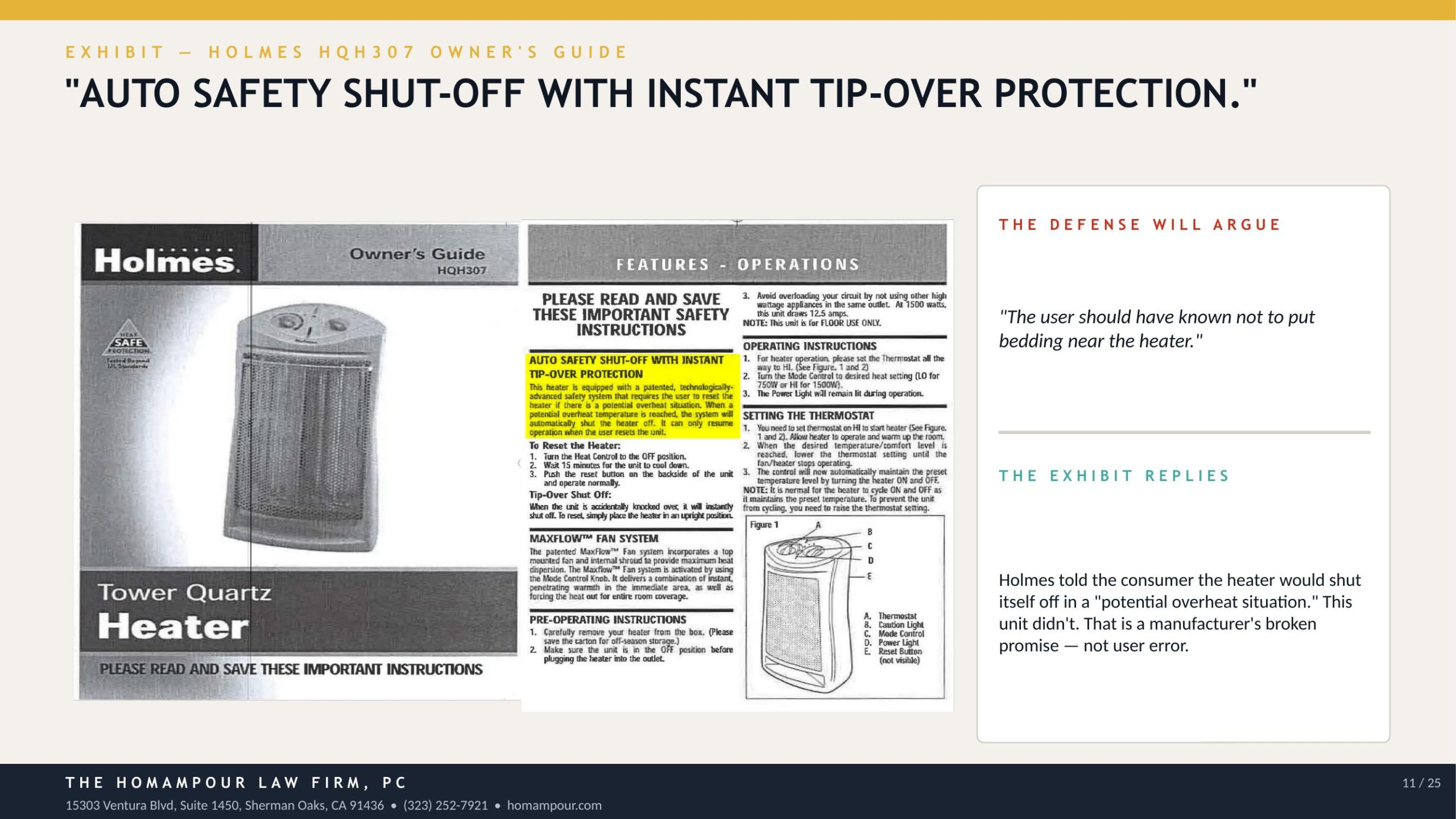
A Holmes HQH307 radiant heater started the fire that killed Amy Shinedling, and a federal jury returned $58.65 million. If a Holmes HQH307 caused a fire, a death, or a serious burn, a Holmes HQH307 space heater lawsuit may follow. Call us first.
Call or refer: (323) 658-8077 · [email protected]
What this page is. A plain-English guide for families and attorneys looking into a Holmes HQH307 space heater lawsuit after a fire. It explains what the product is, what a jury already found about it, and who may have a claim.
What is the Holmes HQH307?
The Holmes HQH307 is a radiant quartz space heater. Holmes is a brand in the Sunbeam and Jarden family, and Sunbeam Products, Inc. designed and manufactured the heater. Like other radiant heaters, it warms objects directly with a very hot quartz element, and it was sold with an advertised automatic safety shutoff that consumers reasonably expected would help prevent a fire.
What the Shinedling jury found
In Shinedling v. Sunbeam Products, Inc. (C.D. Cal. 2015), a federal jury found that the heater was the subject of a failure to warn and of negligent design and negligent failure to warn, and it returned a special verdict of $58,650,000. After a 20% comparative-fault apportionment, the net judgment was approximately $46,920,000. The Ninth Circuit affirmed the wrongful-death portion in 2017. The Ninth Circuit decision is unpublished and is described here as case history, not as binding precedent.
The defect in plain English
A radiant quartz element runs near 1,200 degrees. Common household fabrics ignite near 450 degrees. When clothing fell in front of the heater during the night, the advertised automatic shutoff did not prevent ignition, and the room caught fire. At trial, Sunbeam’s head of safety engineering and its project engineer admitted that the shutoff might not stop a fire and that the company never told consumers. That admission is the heart of a Holmes HQH307 space heater lawsuit.
Who may have a claim
You may have a claim if a Holmes HQH307, or a similar radiant heater in the Sunbeam or Jarden family, was involved in a fire that caused a death, a serious burn, smoke-inhalation injury, or major property loss. A surviving spouse, children, and certain heirs may bring a wrongful-death claim, and a close family member who witnessed the event may have a separate emotional-distress claim. Under Code of Civil Procedure 335.1, the limitations period is generally two years from the injury, or two years from the date of death for wrongful death.
What these cases are worth
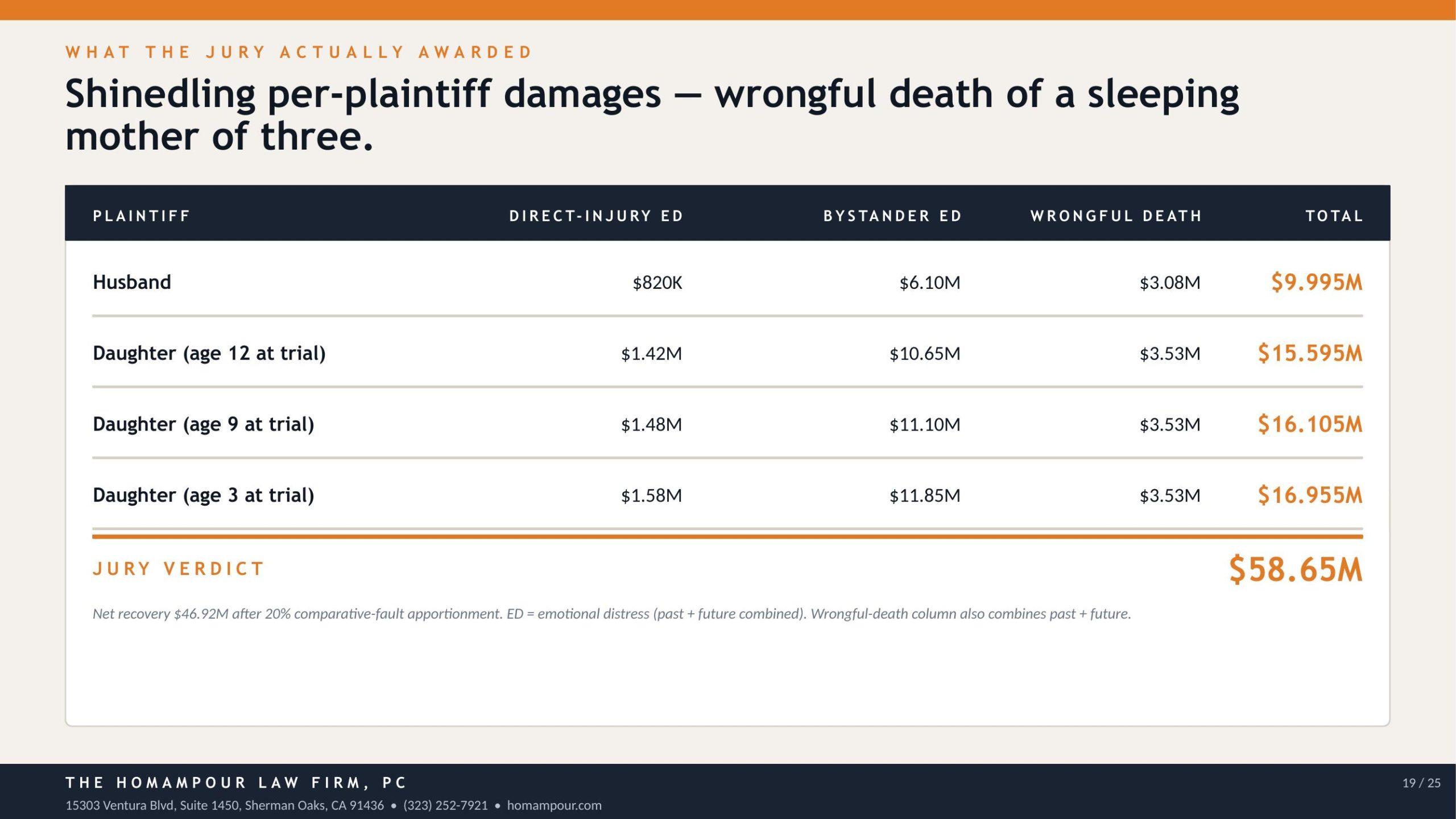
In Shinedling the jury allocated the award by family member: $9,995,000 to the husband and $15,595,000, $16,105,000, and $16,955,000 to the three daughters by age, totaling $58,650,000. Every case is different, but the figures show the scale these cases can reach.
What to do right now
Keep the heater itself, even if it is fire-damaged, and do not discard it. Preserve the scene and any photographs, the purchase records and packaging, and the fire-department report. Get medical records and keep a simple timeline of events. Then call before evidence is lost.
Call us first
Call or refer: (323) 658-8077 · [email protected]. The space-heater demonstrative kit is available as a free PDF. You can also read the broader guide to space heater defect cases.
The Homampour Law Firm, PC · 15303 Ventura Blvd, Suite 1450, Sherman Oaks, CA 91436
Frequently asked questions
How long do I have to file a Holmes HQH307 space heater lawsuit in California?
Generally two years from the date of injury under Code of Civil Procedure 335.1, or two years from the date of death for a wrongful-death claim. Some deadlines are shorter or tolled, so it is best to ask early.
Is there a class action, or is this an individual case?
A serious injury or death from a heater fire is handled as an individual case, not a class action, because the damages are specific to the family. That is how the Shinedling case proceeded.
What if the heater was destroyed in the fire?
A fire-damaged heater is still valuable evidence and should be preserved. Even where the product is badly burned, origin-and-cause analysis, purchase records, and the manufacturer’s own design and testing files can support the case.
What does it cost to pursue a case?
These cases are handled on a contingency fee, so there is no fee unless there is a recovery. A consultation to discuss whether you may have a viable claim is free.
Past results do not guarantee similar outcomes. Every case is different, and the value of any claim depends on its specific facts. This page is attorney advertising and general information, not legal advice, and it does not create an attorney-client relationship.