
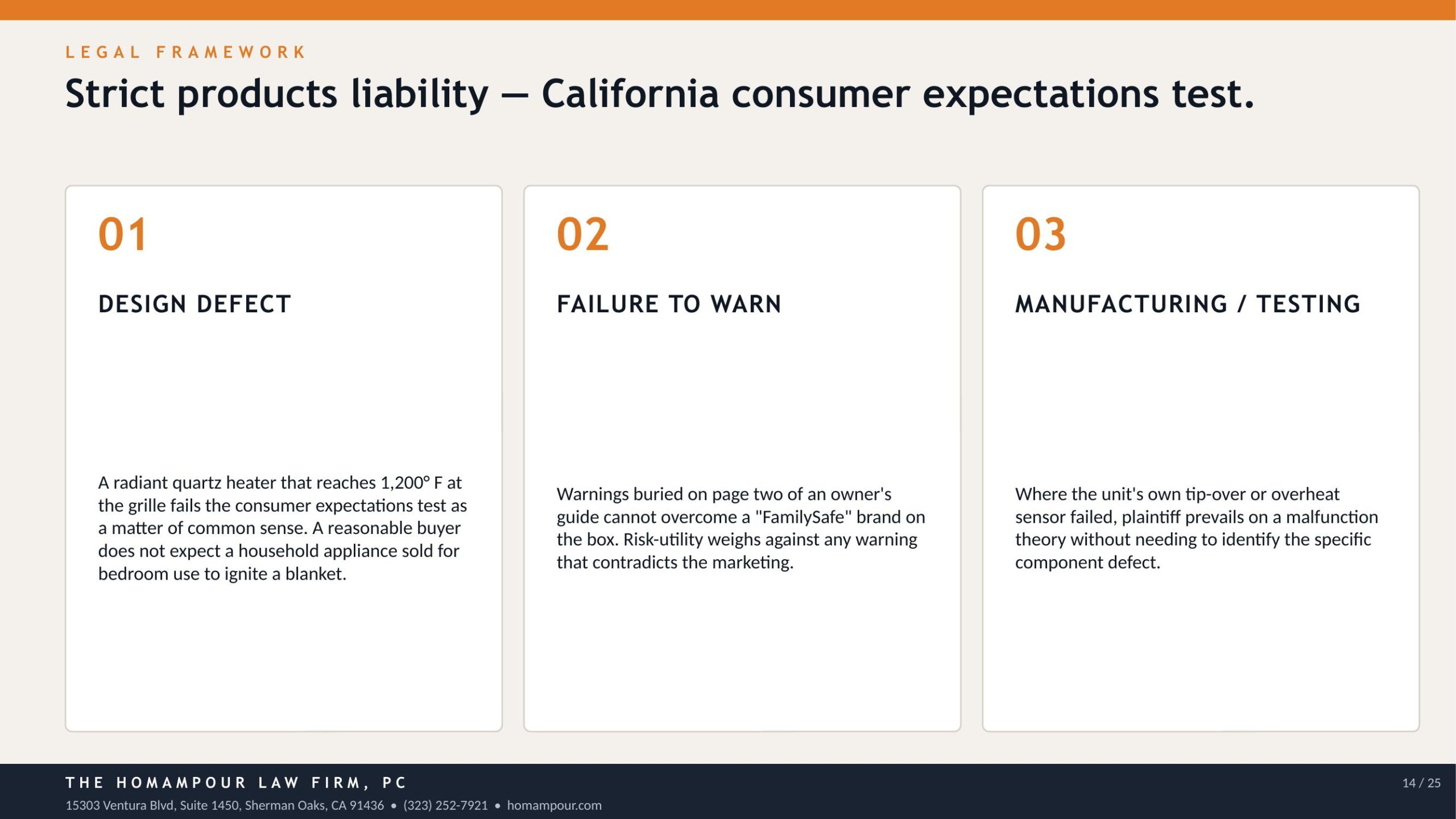
For referring counsel: Strict liability failure to warn in California is often the most durable theory in a defect case. It reaches risks the manufacturer should have known, and it carried the Shinedling verdict.
Refer or co-counsel: (323) 658-8077 · [email protected]
The standard. Anderson v. Owens-Corning Fiberglas Corp. (1991) 53 Cal.3d 987 holds that a manufacturer is strictly liable for failing to warn of a risk that was known or knowable in light of the scientific and medical knowledge available at the time of manufacture. Strict liability failure to warn in California measures the manufacturer against what was knowable, not only what it actually knew.
The elements
A plaintiff proves that the product had potential risks known or knowable at the time of manufacture, that the risks presented a substantial danger when the product was used in a reasonably foreseeable way, that ordinary consumers would not have recognized the risk, that the manufacturer failed to give an adequate warning, and that the lack of warning was a substantial factor in causing harm. See CACI 1205.
Two features matter most. The standard is knowability, not actual knowledge. And the risk must be substantial and unfamiliar to ordinary consumers. A sharp knife needs no warning that it cuts. A heater that quietly fails its advertised safety feature does, because no ordinary consumer expects that failure.
The Shinedling application
This theory carried the verdict. Sunbeam’s head of safety engineering and its project engineer admitted on cross-examination that the automatic shutoff might fail when combustibles fell in front of the heater, and that Sunbeam never told consumers. The Consumer Product Safety Commission had published bulletins on radiant-heater fire risk. The knowable risk was established, the danger was substantial, the consumer would not have expected it, and there was no adequate warning. The jury answered yes on every element.
What the manufacturer can and cannot argue
The manufacturer can argue that the risk was unknowable at the time of manufacture, which is Anderson’s central limit, though that defense usually fails because most consumer-product risks were knowable. It can argue the warning was adequate, which is generally a jury question. And it can try to rebut the heeding presumption by showing the plaintiff would not have followed a different warning.
The manufacturer cannot argue that it did its best, because the state-of-the-art reasonableness defense belongs to negligence, not strict liability. It cannot treat industry-standard compliance as dispositive, because custom is evidence but not a defense.
Practice points
Build the knowability record early through industry publications, CPSC bulletins from the Consumer Product Safety Commission, scientific literature, internal testing, and competitor warnings. Hold the manufacturer’s engineers to their admissions. Plead negligent failure to warn alongside the strict-liability theory. And develop the consumer-perspective evidence: what would the consumer have done if warned. In Shinedling, the answer was that the family would have bought a safer heater that was cheap and available.
Refer or co-counsel
The firm accepts defective-product referrals across California and pays a referral fee consistent with California Rule of Professional Conduct 1.5.1, with a written fee-division agreement and the client’s written consent.
The Homampour Law Firm, PC · 15303 Ventura Blvd, Suite 1450, Sherman Oaks, CA 91436
Refer or co-counsel: (323) 658-8077 · [email protected] · homampour.com
Frequently asked questions
What are the elements of strict-liability failure to warn in California?
A knowable risk at the time of manufacture, a substantial danger in foreseeable use, a risk ordinary consumers would not recognize, the absence of an adequate warning, and causation. See CACI 1205.
What does “known or knowable” mean under Anderson?
It means the manufacturer is measured against the scientific and medical knowledge available at the time of manufacture, not only what it personally knew. A risk it should have discovered is treated as knowable.
Is compliance with industry standards a defense?
No. Compliance is evidence of adequacy but it is not dispositive, and following industry custom does not bar a strict-liability failure-to-warn claim.
Free download
The space-heater demonstrative kit is available as a PDF and an editable PPTX.
Past results do not guarantee similar outcomes. Every case is different. This page is attorney advertising and general information, not legal advice, and it does not create an attorney-client relationship.