
For referring counsel: The parallel product liability theories Shinedling lesson is the most important page in this cluster. The jury rejected design defect and still returned $58.65M, because three other theories were in the case.
Refer or co-counsel: (323) 658-8077 · [email protected]
The single point. Plead every theory the facts support. The parallel product liability theories Shinedling outcome shows what happens when you do, and what would have happened if you did not.
The special verdict, theory by theory
The jury answered a special verdict in Shinedling v. Sunbeam Products, Inc. On strict-liability design defect, it answered yes on the consumer-expectation prong, but no on causation, and no on the risk-benefit prong. On strict-liability failure to warn, it answered yes on every element. On negligent design, it answered yes on every element. On negligent failure to warn, it answered yes on every element.
Three theories carried the verdict. One did not. A complaint that pleaded only strict-liability design defect would have produced a defense verdict on this exact evidence.
What the result was
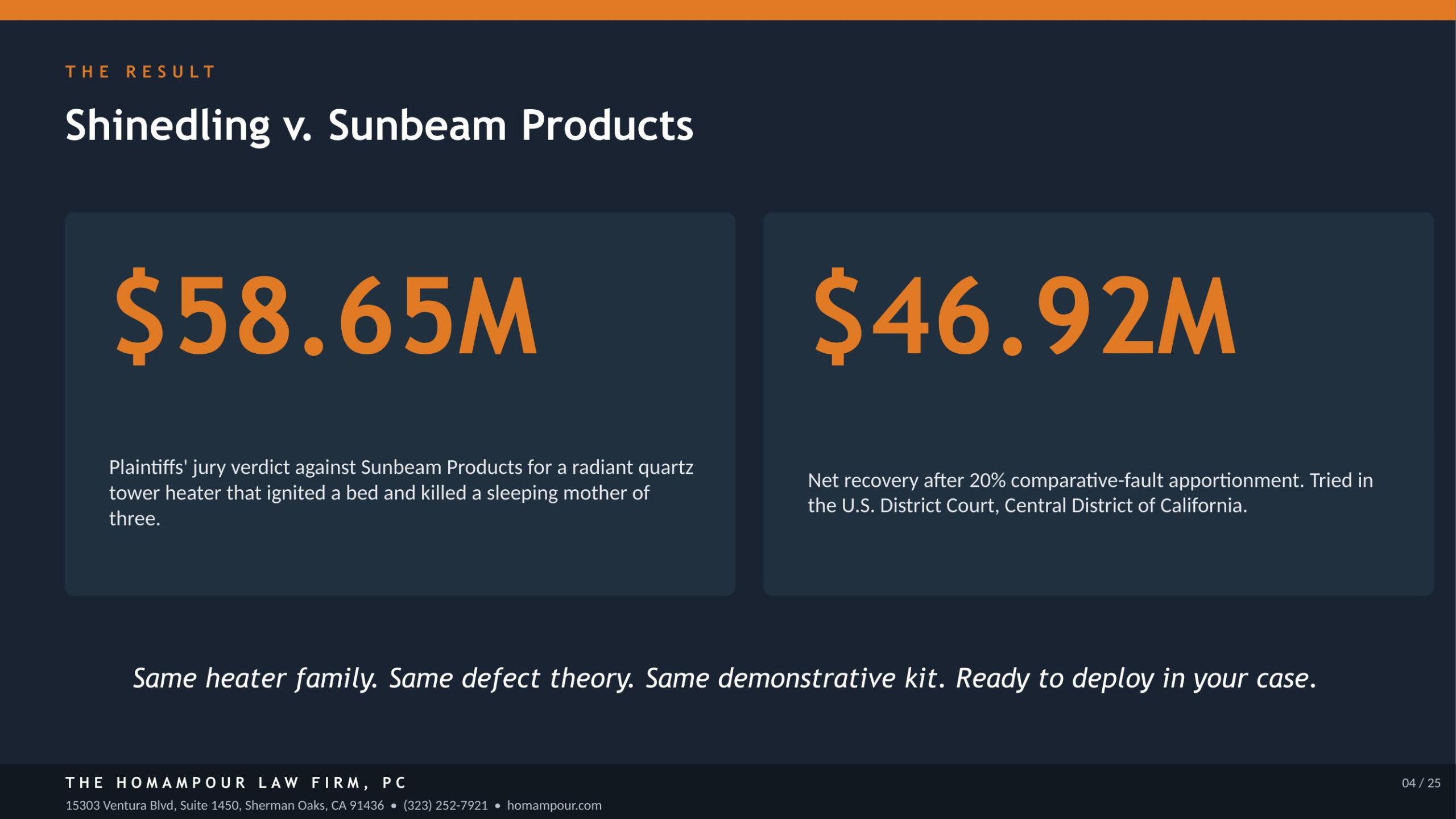
The jury returned $58,650,000 in wrongful-death and bystander emotional-distress damages, then apportioned 80% of fault to Sunbeam and 20% to Kenneth Shinedling. The net judgment was approximately $46,920,000. The Ninth Circuit affirmed the wrongful-death portion in 2017.
Why design defect failed but the case did not
Design defect can fail for reasons that have nothing to do with the strength of the case. A jury can decide the design met consumer expectations on one question, then balk at the causation link between the design choice and this particular fire. Meanwhile the failure-to-warn theory asks a different question, whether the manufacturer should have told consumers about a knowable risk, and the negligence theories ask whether the manufacturer acted reasonably. Those questions had clean yes answers here because Sunbeam’s own engineers admitted the shutoff could fail and that consumers were never told.
The pleading lesson for referring counsel
Plead strict-liability design defect under both Barker tests, strict-liability failure to warn, negligent design and negligent failure to warn, and manufacturing defect where the facts allow. Develop the conduct evidence that powers the negligence and warning theories. And build the case so that the loss of any one theory does not sink the verdict. The parallel product liability theories Shinedling proved are simple to plead and decisive at trial.
Refer or co-counsel
The firm accepts defective-product referrals across California and pays a referral fee consistent with California Rule of Professional Conduct 1.5.1, with a written fee-division agreement and the client’s written consent.
The Homampour Law Firm, PC · 15303 Ventura Blvd, Suite 1450, Sherman Oaks, CA 91436
Refer or co-counsel: (323) 658-8077 · [email protected] · homampour.com
Frequently asked questions
What does Shinedling teach about pleading product cases?
The parallel product liability theories Shinedling outcome shows why you plead every supported theory. In Shinedling the jury rejected strict-liability design defect but found strict-liability failure to warn, negligent design, and negligent failure to warn, so three parallel theories carried the verdict.
How did the Shinedling verdict break down?
The jury returned $58,650,000 and apportioned 80% of fault to Sunbeam and 20% to the plaintiff, for a net judgment of about $46,920,000. The Ninth Circuit affirmed the wrongful-death portion in 2017.
Why did the design-defect theory fail?
The jury answered yes on consumer expectation but no on causation, and no on risk-benefit. Those answers did not defeat the warning and negligence theories, which rest on different questions.
Free download
The space-heater demonstrative kit is available as a PDF and an editable PPTX.
Past results do not guarantee similar outcomes. Every case is different, and the value of any claim depends on its specific facts. This page is attorney advertising and general information, not legal advice, and it does not create an attorney-client relationship.