
For referring counsel: The manufacturer duty to test, investigate, and warn is an independent obligation that does not end when the product ships. It is the doctrine that turns a quiet safety risk into a clear breach.
Refer or co-counsel: (323) 658-8077 · [email protected]
The principle. A manufacturer cannot stay deliberately ignorant of its own product’s dangers. California law imposes a manufacturer duty to test the product for foreseeable risks, to keep current with industry and government safety knowledge, and to warn when a risk becomes known or knowable. This duty supports the negligence theories and frames the conduct story at trial.
What the duty requires
The duty has three connected parts. Test: evaluate the product for the dangers that arise in reasonably foreseeable use, including foreseeable misuse. Investigate: stay current with the knowledge a reasonable manufacturer in the field would have, including Consumer Product Safety Commission bulletins, recognized standards, scientific literature, and field reports of failures. Warn: give consumers an adequate warning of a knowable, non-obvious risk, and update warnings as new information arrives.
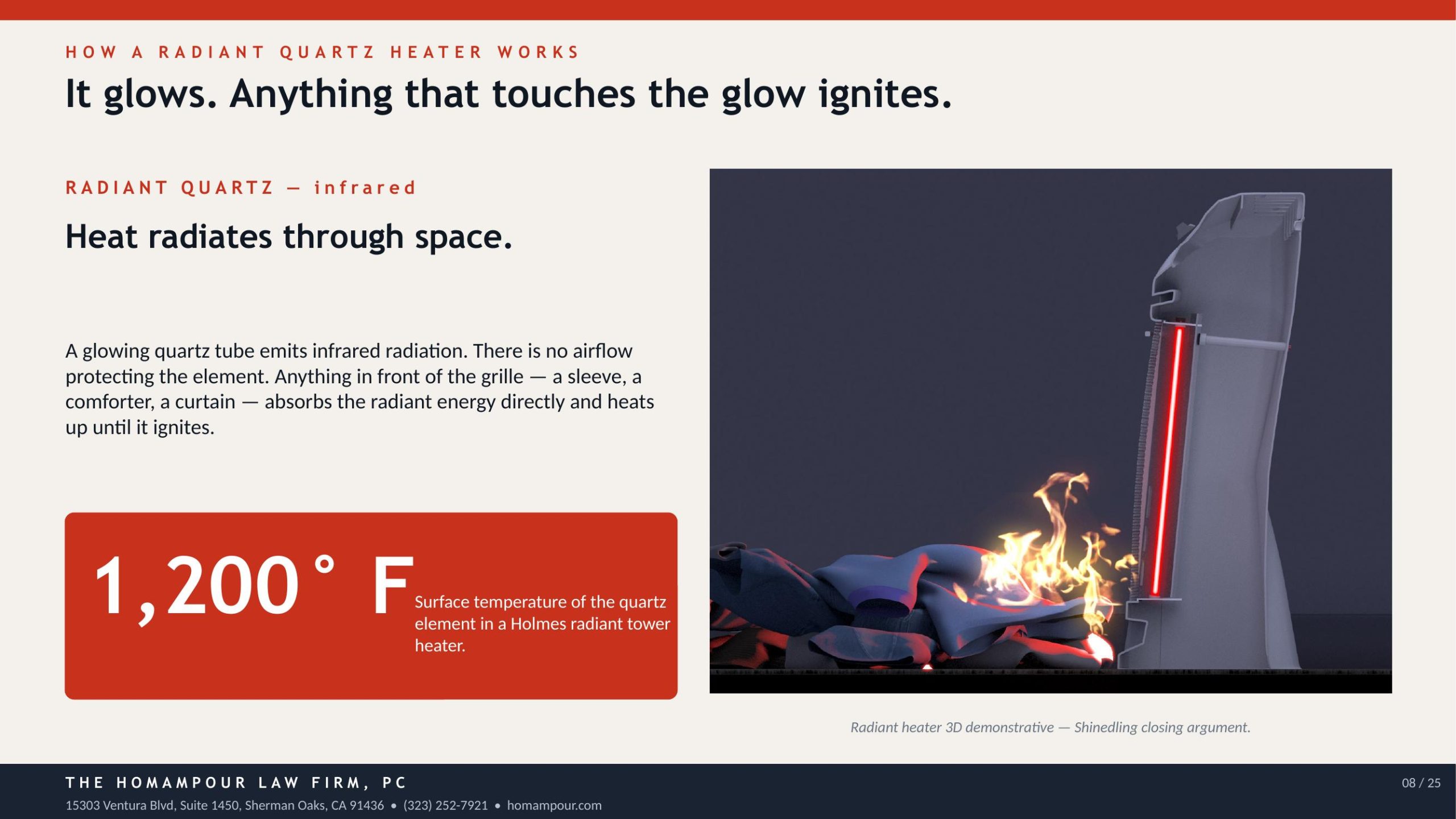
A radiant quartz heater reaches roughly 1,200 degrees at the element, while common household materials ignite near 450 degrees. A manufacturer that knows those numbers, and that an automatic shutoff may not prevent ignition when fabric falls against the heater, owes consumers that information.
The Shinedling proof of breach
The breach was proven from the manufacturer’s own witnesses. Sunbeam’s head of safety engineering and its project engineer admitted that the automatic shutoff might fail when combustibles contacted the heater, and that Sunbeam never told consumers. The Consumer Product Safety Commission had flagged radiant-heater fire risk in published bulletins. The risk was knowable, the manufacturer had the knowledge, and the warning never came. That is the manufacturer duty to test, investigate, and warn, broken in plain view.
How to develop the duty in discovery
Request the design-history file, the testing protocols and results, the hazard analyses, the warning-development records, the CPSC correspondence, and the prior-incident and complaint history. The discovery roadmap page lays out the full sequence. The goal is to show the manufacturer either knew or refused to learn, and either way failed to warn.
Practice points
Tie the affirmative duty to the negligence theories. Use the manufacturer’s own documents and engineers to prove the knowledge. And present the duty as a simple promise the manufacturer made to the public and broke.
Refer or co-counsel
The firm accepts defective-product referrals across California and pays a referral fee consistent with California Rule of Professional Conduct 1.5.1, with a written fee-division agreement and the client’s written consent.
The Homampour Law Firm, PC · 15303 Ventura Blvd, Suite 1450, Sherman Oaks, CA 91436
Refer or co-counsel: (323) 658-8077 · [email protected] · homampour.com
Frequently asked questions
What is a manufacturer’s affirmative duty in California?
It is the obligation to test products for foreseeable dangers, to stay current with industry and government safety knowledge, and to warn of knowable, non-obvious risks. It supports the negligence theories.
Does the duty end when the product is sold?
No. The duty to stay informed and to warn continues as new risk information becomes known or knowable, which is why field reports and CPSC bulletins matter.
How was the duty breached in Shinedling?
Sunbeam’s own engineers admitted the automatic shutoff might fail and that consumers were never warned, even though the radiant-heater fire risk was knowable and flagged by the Consumer Product Safety Commission.
Free download
The space-heater demonstrative kit is available as a PDF and an editable PPTX.
Past results do not guarantee similar outcomes. Every case is different. This page is attorney advertising and general information, not legal advice, and it does not create an attorney-client relationship.