
For referring counsel: Defeating product defense narratives is mostly about one move. The manufacturer wants the trial to be about the consumer. You keep it about the product and the manufacturer’s own knowledge.
Refer or co-counsel: (323) 658-8077 · [email protected]
The defense playbook. In nearly every defect case, the manufacturer tries to shift the jury’s attention from the product to the plaintiff. Defeating product defense narratives means recognizing each move and answering it with foreseeable use, the manufacturer’s own admissions, and a clean causation story.
The recurring defense moves
The defense usually argues some mix of the following: the consumer misused the product, the consumer ignored a warning, the risk was obvious, the product met industry standards, the injury would have happened anyway, and the plaintiff’s expert is unreliable. Each move sounds reasonable in isolation. Each has a direct answer.
The answers
Foreseeable use and misuse. A manufacturer is liable for harm from reasonably foreseeable use, which includes foreseeable misuse. Running a space heater overnight, or having clothing near it, is foreseeable. CACI 1203 builds foreseeable use into the consumer-expectation test.
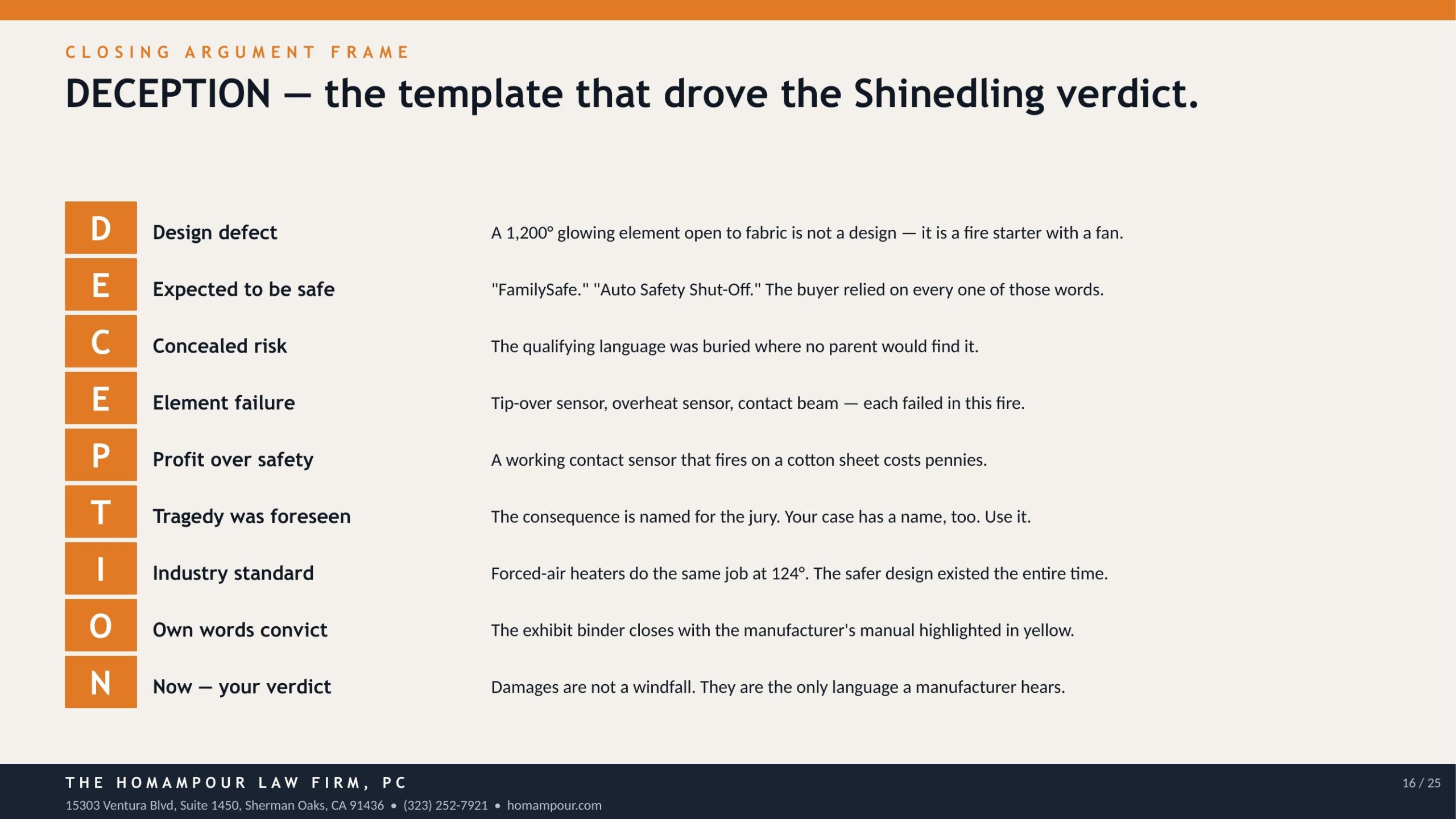
The obvious-risk argument. A quietly failing safety feature is not an obvious risk. A consumer told the heater will shut off does not expect it to start a fire.
Industry standards. Compliance is evidence, not a defense. Custom does not immunize a manufacturer whose product was defective or whose warning was inadequate.
Causation. Keep the chain simple: defective product, foreseeable use, fire, death. The manufacturer’s engineers admitted the shutoff could fail and that consumers were never told, which closed the causation loop.
The Shinedling demonstration
The closing-argument framework organized the manufacturer’s conduct into a single, memorable theme: the company knew and did not tell. The defense wanted the case to be about a family that ran a heater at night. The plaintiffs kept it about a manufacturer that sold an advertised safety feature it knew might not work. Defeating product defense narratives came down to refusing to try the consumer and insisting on trying the product.
Practice points
Pre-empt the blame story in voir dire and opening. Anchor every answer in foreseeable use. Use the manufacturer’s own witnesses against it. And give the jury one clean theme that survives cross-examination. The comparative-fault page explains how holding the apportionment down protects the verdict.
Refer or co-counsel
The firm accepts defective-product referrals across California and pays a referral fee consistent with California Rule of Professional Conduct 1.5.1, with a written fee-division agreement and the client’s written consent.
The Homampour Law Firm, PC · 15303 Ventura Blvd, Suite 1450, Sherman Oaks, CA 91436
Refer or co-counsel: (323) 658-8077 · [email protected] · homampour.com
Frequently asked questions
What is the blame-the-consumer defense?
It is the manufacturer’s effort to shift the jury’s focus from the defective product to the plaintiff’s conduct, by arguing misuse, an obvious risk, or that the injury would have happened anyway.
How does foreseeable use defeat the defense?
A manufacturer is responsible for harm from reasonably foreseeable use, including foreseeable misuse. Ordinary consumer behavior, such as running a heater overnight, is foreseeable and does not excuse a defective product.
Is compliance with industry standards a complete defense?
No. Compliance is evidence the jury may weigh, but custom does not immunize a manufacturer whose product was defective or whose warning was inadequate.
Free download
The space-heater demonstrative kit is available as a PDF and an editable PPTX.
Past results do not guarantee similar outcomes. Every case is different. This page is attorney advertising and general information, not legal advice, and it does not create an attorney-client relationship.