
For referring counsel: Greenman strict product liability is the root of every California defect claim. Understanding what Greenman decided, and what it deliberately left out, sets up every motion and jury argument that follows.
Refer or co-counsel: (323) 658-8077 · [email protected]
The starting point. Before 1963 an injured consumer usually had to prove negligence or sue on a contract warranty. Greenman v. Yuba Power Products, Inc. (1963) 59 Cal.2d 57 changed that. Justice Roger Traynor held that a manufacturer is strictly liable in tort when it places a product on the market, knowing it will be used without inspection, and a defect causes injury. Greenman strict product liability does not depend on fault.
What the decision established
The plaintiff was hurt when a piece of wood flew out of a combination power tool. The California Supreme Court held that he did not need to prove the manufacturer was careless, and he did not need contractual privity. Liability attached because the product was defective and the defect caused harm.
Traynor’s reasoning was as much about economics as doctrine. Manufacturers, not injured consumers, are best positioned to absorb and spread the cost of product injuries. That cost-allocation principle is the moral architecture of California product law, and it still frames closing argument today.
Why Greenman still controls in 2026
Three features keep Greenman strict product liability central.
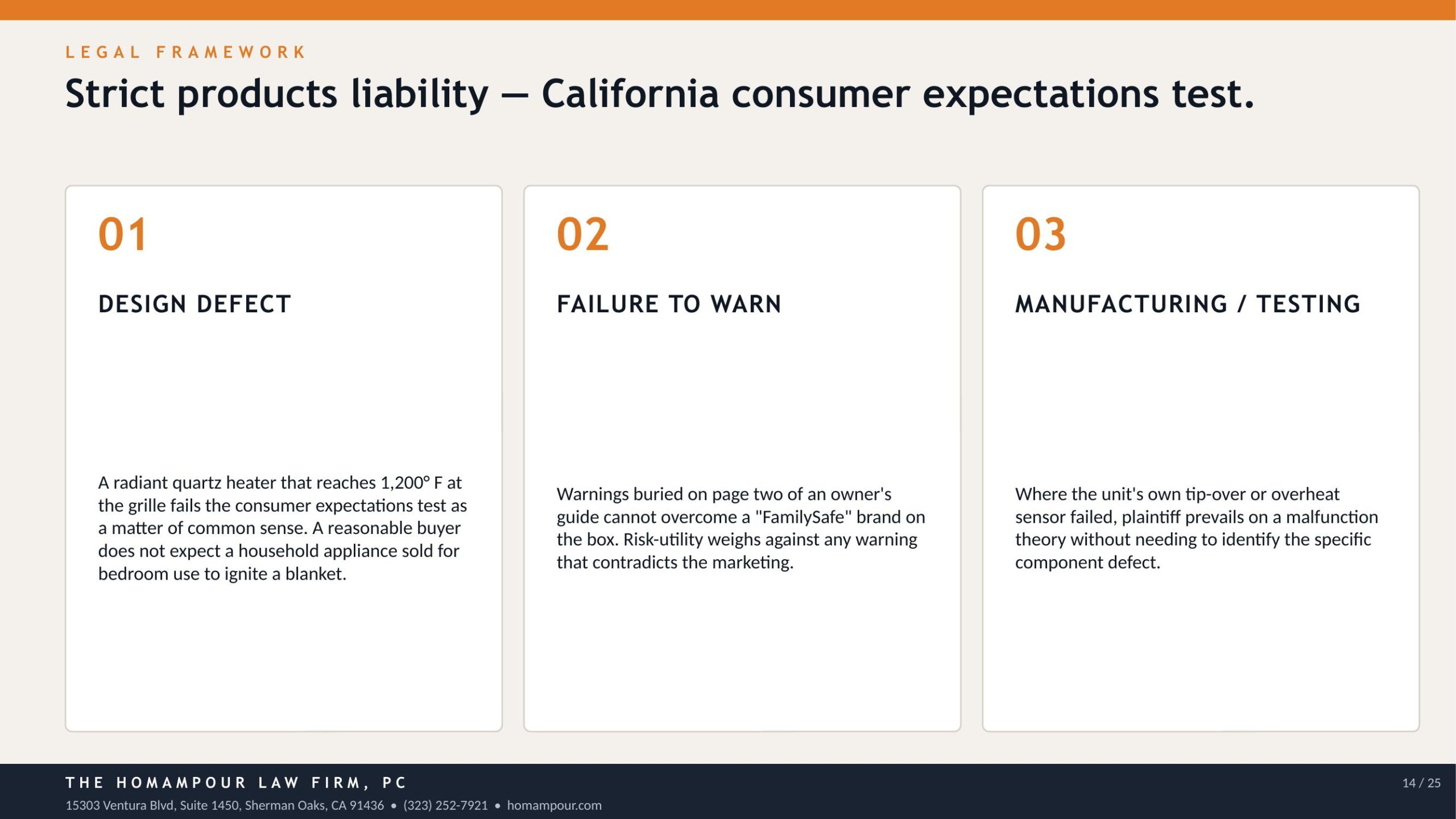
First, it is the source of the modern doctrine, later organized into the design-defect, manufacturing-defect, and failure-to-warn branches.
Second, it fixes who is liable and on what basis, regardless of contract posture. Everyone in the chain of distribution who profits from placing the product in commerce can answer for the defect.
Third, it reframes the trial. The question is not whether the manufacturer tried hard. The question is whether the product was defective and whether the defect caused the injury.
What Greenman does not decide
Greenman did not adopt a single test for what makes a design defective. That came later in Barker v. Lull. It did not address the knowable-risk standard for warnings, which arrived in Anderson v. Owens-Corning. And it did not displace negligence; the parallel negligence theories remain independent causes of action.
Practice points
Plead Greenman strict liability separately from negligence, because they carry independent elements. In argument, return to Traynor’s cost-allocation rationale. And in opposition to summary judgment, Greenman answers any defense argument that turns on how careful the manufacturer was, because strict liability does not turn on conduct. The strategic payoff of keeping multiple theories alive is detailed in why parallel theories win.
Refer or co-counsel
The firm accepts defective-product referrals across California and pays a referral fee consistent with California Rule of Professional Conduct 1.5.1, with a written fee-division agreement and the client’s written consent.
The Homampour Law Firm, PC · 15303 Ventura Blvd, Suite 1450, Sherman Oaks, CA 91436
Refer or co-counsel: (323) 658-8077 · [email protected] · homampour.com
Frequently asked questions
What did Greenman v. Yuba Power Products establish?
It established strict liability in tort for defective products in California. A manufacturer that places a product on the market knowing it will be used without inspection is liable when a defect causes injury, without proof of negligence or a contract warranty.
Does Greenman eliminate the need to prove the manufacturer was negligent?
Yes for the strict-liability claim. The plaintiff proves a defect and causation, not carelessness. Negligence remains a separate, parallel theory that reaches the manufacturer’s conduct.
Is privity required to sue under Greenman?
No. Greenman strict product liability does not require a contract between the consumer and the manufacturer. Liability runs to those who place the defective product in the stream of commerce.
Free download
The space-heater demonstrative kit is available as a PDF and an editable PPTX.
Past results do not guarantee similar outcomes. Every case is different. This page is attorney advertising and general information, not legal advice, and it does not create an attorney-client relationship.