
For referring counsel: The Soule consumer expectation test question is the defense’s first motion in almost every design case. Win it by framing the failure in plain, everyday terms, and always keep risk-benefit in reserve.
Refer or co-counsel: (323) 658-8077 · [email protected]
The rule. Soule v. General Motors Corp. (1994) 8 Cal.4th 548 held that the consumer-expectation test is available only when the everyday experience of the product’s users permits a conclusion that the design did not meet minimum safety assumptions. The Soule consumer expectation test cannot be used where the question of safe design turns on technical and mechanical details beyond the common experience of jurors.
What Soule decided
In Soule the plaintiff’s ankles were injured in a car crash, and the design question involved the behavior of the vehicle’s frame and wheel assembly under collision forces. That was a technical question. The court held the consumer-expectation instruction should not have been given, because ordinary drivers have no fixed expectation about how a wheel assembly should perform in a specific crash. The proper test there was risk-benefit, with expert testimony.
Why Soule matters
First, it limits but does not eliminate the consumer-expectation route. Where everyday experience supports a safety expectation, the test remains available.
Second, it gives the defense its opening motion. Expect a motion in limine to strike consumer expectation in any case with engineering content. Be ready to defend the instruction or to pivot.
Third, risk-benefit is always available. Even if the Soule consumer expectation test is foreclosed, the risk-benefit test with its burden shift remains.
How to defend the instruction
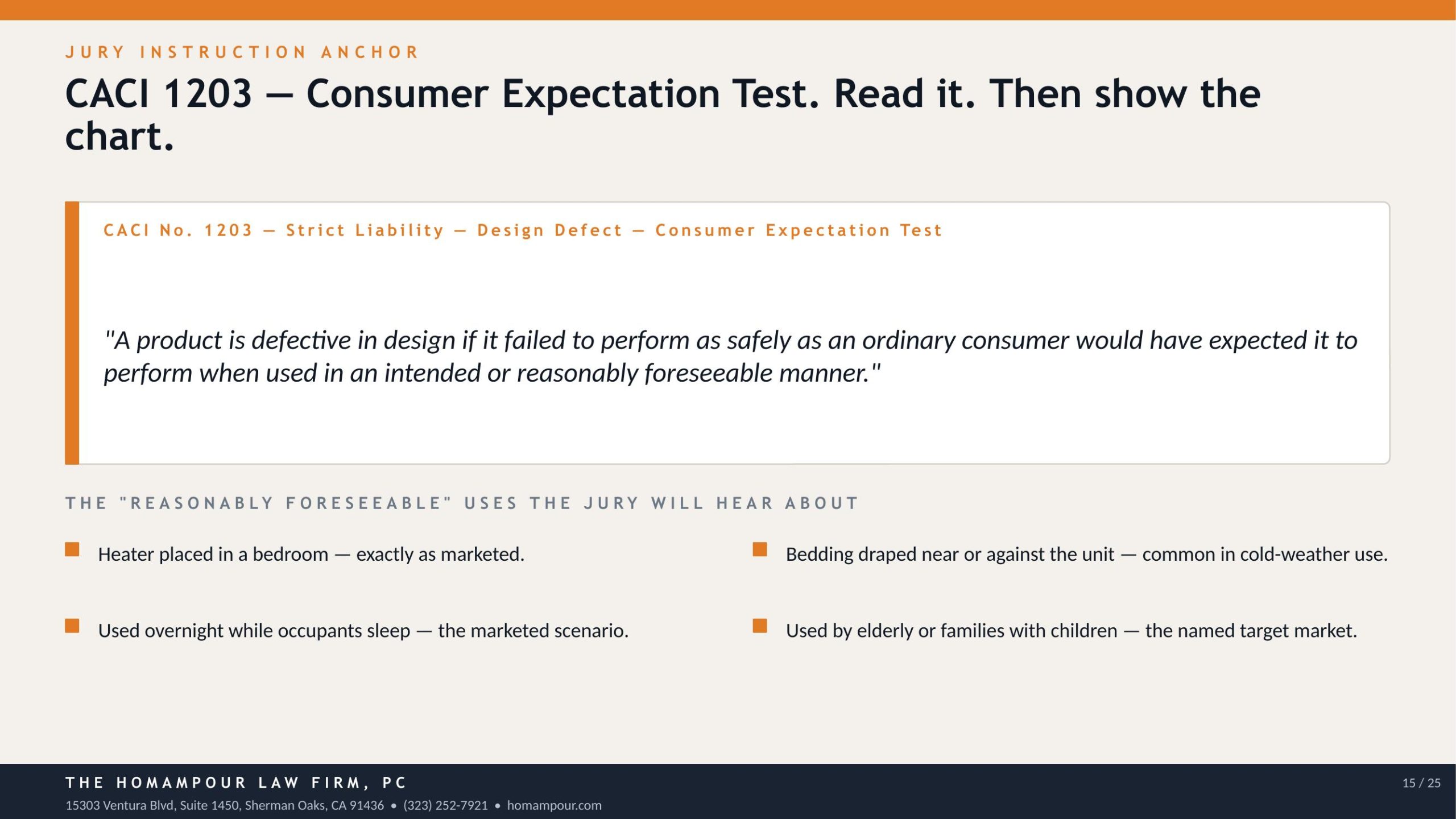
Frame the design failure in consumer-friendly terms and avoid engineering vocabulary in the opposition. The simpler the failure mode reads, the stronger the consumer-expectation case. Where the product carried a specific safety claim, such as an advertised automatic shutoff, that marketing creates the very expectation Soule protects. A consumer who is told a heater will shut off has an everyday expectation that it will not start a fire.
The Shinedling application
The Holmes HQH307 was sold with an advertised safety shutoff. An ordinary buyer expects that feature to prevent a fire if something falls against the heater. That is a classic consumer expectation, not an esoteric engineering judgment, which is why the consumer-expectation theory was properly in the case even though the jury ultimately rested its verdict on the warning and negligence theories. The takeaway is to plead both design tests and let the parallel theories protect the verdict.
Practice points
Plead both design tests even when you expect to lose consumer expectation at the in limine stage, because some judges deny Soule motions on close facts and risk-benefit stands on its own. Keep the failure mode simple. And tie any advertised safety claim directly to the consumer’s expectation.
Refer or co-counsel
The firm accepts defective-product referrals across California and pays a referral fee consistent with California Rule of Professional Conduct 1.5.1, with a written fee-division agreement and the client’s written consent.
The Homampour Law Firm, PC · 15303 Ventura Blvd, Suite 1450, Sherman Oaks, CA 91436
Refer or co-counsel: (323) 658-8077 · [email protected] · homampour.com
Frequently asked questions
When can the consumer-expectation test be used in California?
When the everyday experience of the product’s users supports a conclusion that the product did not meet minimum safety assumptions. It cannot be used where safe design turns on technical details beyond common experience.
Does Soule eliminate the consumer-expectation test?
No. It limits the test to cases within ordinary consumer experience. The risk-benefit test remains available in every design-defect case.
How does a plaintiff defend the test against a Soule motion?
Frame the failure in plain terms, avoid engineering jargon, and connect any advertised safety claim to the consumer’s expectation. Then keep risk-benefit in reserve.
Free download
The space-heater demonstrative kit is available as a PDF and an editable PPTX.
Past results do not guarantee similar outcomes. Every case is different. This page is attorney advertising and general information, not legal advice, and it does not create an attorney-client relationship.