
For referring counsel: The Barker Lull design defect tests are the two independent ways to prove a defective design in California. Plead both. A jury can reject one and still find for the plaintiff on the other.
Refer or co-counsel: (323) 658-8077 · [email protected]
The framework. Barker v. Lull Engineering Co. (1978) 20 Cal.3d 413 held that a product has a design defect if it fails either of two tests. The Barker Lull design defect tests are independent. A plaintiff may rely on one, the other, or both.
The two tests
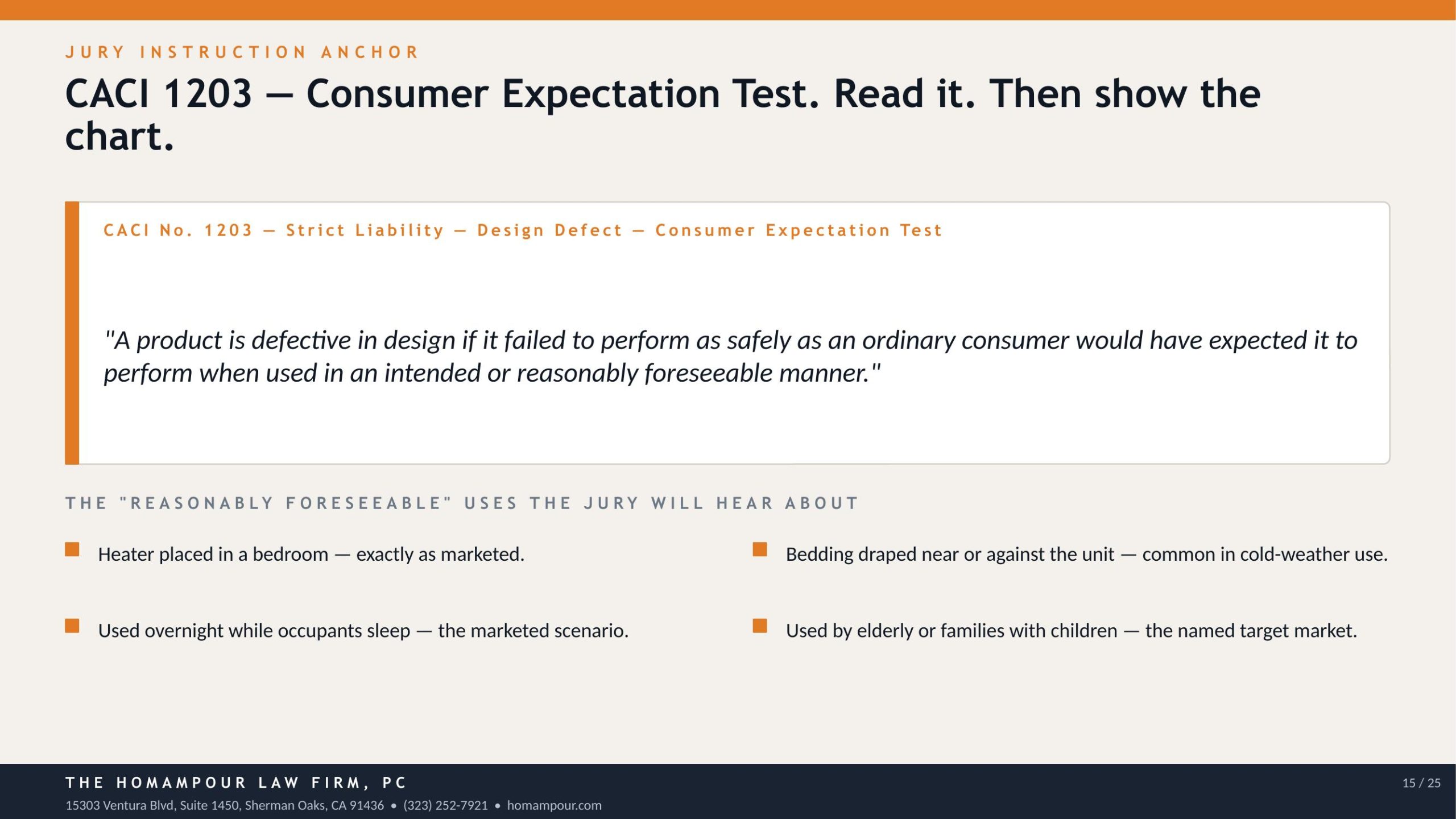
Consumer-expectation test (CACI 1203). A product is defective if it did not perform as safely as an ordinary consumer would expect when used in a reasonably foreseeable way. This test draws on everyday experience and does not require expert engineering testimony about design alternatives.
Risk-benefit test (CACI 1204). A product is defective if its design embodies excessive preventable danger, that is, if the risks of the design outweigh its benefits. Courts weigh the gravity of the danger, the likelihood it would occur, the feasibility of a safer alternative, the cost of that alternative, and the adverse consequences of the alternative.
The feature that matters most: burden shifting
On the risk-benefit test, once the plaintiff shows the design caused the injury, the burden shifts to the manufacturer to prove that the benefits of the design outweigh its risks. That burden shift is the most powerful structural advantage in California design-defect law. Risk-benefit is also a strict-liability test, not a negligence test, so the manufacturer cannot defend simply by showing it acted reasonably.
When each test is available
The consumer-expectation test is reserved for cases where the everyday experience of the product’s users supports a conclusion about safe performance. The risk-benefit test is always available. The limits on consumer expectation come from Soule v. General Motors, which restricts the consumer-expectation instruction in cases that turn on technical design questions beyond ordinary experience.
The Shinedling application
A consumer buys a space heater that advertises an automatic shutoff. The consumer expects it to prevent a fire if something falls in front of it. When it does not, the consumer-expectation theory fits, because no engineering degree is needed to grasp the failed promise. In Shinedling, however, the jury answered yes on consumer expectation but no on causation for design defect, and no on risk-benefit. The lesson is not that the Barker Lull design defect tests are weak. The lesson is that design defect must travel with the parallel theories that carried the verdict.
Practice points
Always plead both tests, because CACI 1203 and CACI 1204 are independent rather than alternative. Fight to keep both instructions in the case at the conference. On risk-benefit, build out every Barker factor as if you carry the burden, so that when it shifts you overwhelm the standard rather than barely meet it. And prepare for the split verdict, because a yes on defect with a no on causation is exactly why parallel theories exist.
Refer or co-counsel
The firm accepts defective-product referrals across California and pays a referral fee consistent with California Rule of Professional Conduct 1.5.1, with a written fee-division agreement and the client’s written consent.
The Homampour Law Firm, PC · 15303 Ventura Blvd, Suite 1450, Sherman Oaks, CA 91436
Refer or co-counsel: (323) 658-8077 · [email protected] · homampour.com
Frequently asked questions
What are the two design-defect tests under Barker v. Lull?
The consumer-expectation test and the risk-benefit test. A design is defective if it fails either one. They are independent, and a plaintiff may rely on both.
Who bears the burden on the risk-benefit test?
Once the plaintiff shows the design caused the injury, the burden shifts to the manufacturer to prove the benefits of the design outweigh its risks. That burden shift is the plaintiff’s strongest tool.
Did the Shinedling jury find a design defect?
No. The jury answered yes on consumer expectation but no on causation, and no on risk-benefit. The plaintiffs still prevailed because the failure-to-warn and negligence theories carried the verdict.
Free download
The space-heater demonstrative kit is available as a PDF and an editable PPTX.
Past results do not guarantee similar outcomes. Every case is different. This page is attorney advertising and general information, not legal advice, and it does not create an attorney-client relationship.