
For referring counsel: Comparative fault Prop 51 product liability mechanics decide how much of a verdict the plaintiff keeps. In Shinedling a 20% apportionment reduced a $58.65M verdict to a net judgment near $46.92M.
Refer or co-counsel: (323) 658-8077 · [email protected]
The framework. Strict liability does not exempt a plaintiff from comparative-fault apportionment. At the same time, Proposition 51, codified at Civil Code 1431.2, makes each defendant severally liable for non-economic damages in proportion to fault. Comparative fault Prop 51 product liability rules therefore shape both the apportionment and the collectability of a verdict.
How comparative fault applies to a strict-liability case
A defendant can argue that the plaintiff’s own conduct was a contributing cause and ask the jury to assign a percentage of fault. The jury then reduces the plaintiff’s recovery by that percentage. The reduction applies even though the manufacturer is strictly liable, because comparative principles run through California tort law.
In Shinedling the jury assigned 80% of the fault to Sunbeam and 20% to Kenneth Shinedling. The $58,650,000 verdict was reduced accordingly, producing a net judgment of approximately $46,920,000.
What Prop 51 does and does not change
Proposition 51 splits damages into two buckets. For economic damages, defendants remain jointly and severally liable, so a plaintiff can collect the full economic award from any liable defendant. For non-economic damages, each defendant pays only its proportional share. In a single-manufacturer case, the practical effect is mostly the comparative reduction; in a multi-defendant case, Prop 51 can strand part of the non-economic award if a defendant is insolvent.
Why the manufacturer rarely shifts much fault in a defect case
When the defect is the manufacturer’s, the blame-the-consumer story usually rings hollow. The plaintiff used the product as people use such products. The defense will try to magnify ordinary consumer behavior into fault, which is the heart of the blame-the-consumer playbook. The answer is foreseeable use: a consumer who runs a heater overnight is using it the way the manufacturer expected.
Practice points
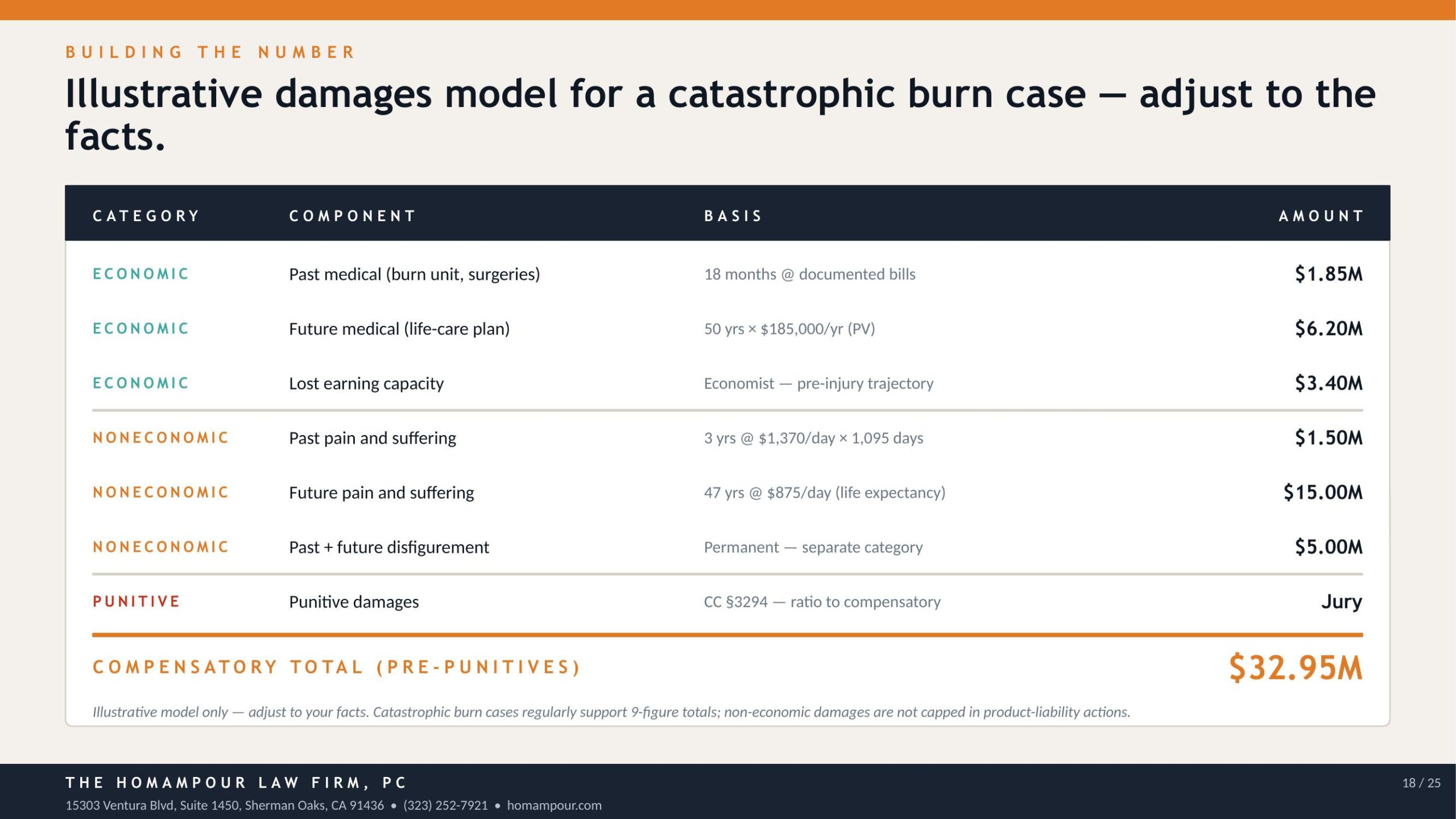
Comparative fault Prop 51 product liability planning should begin at intake: model the exposure early and prepare the foreseeable-use evidence that holds the apportionment down. In multi-defendant cases, map the Prop 51 non-economic allocation against each defendant’s solvency. And present the damages with a clear per-plaintiff structure so the jury understands what each claimant lost.
Refer or co-counsel
The firm accepts defective-product referrals across California and pays a referral fee consistent with California Rule of Professional Conduct 1.5.1, with a written fee-division agreement and the client’s written consent.
The Homampour Law Firm, PC · 15303 Ventura Blvd, Suite 1450, Sherman Oaks, CA 91436
Refer or co-counsel: (323) 658-8077 · [email protected] · homampour.com
Frequently asked questions
Does comparative fault apply to strict product liability in California?
Yes. A jury may assign the plaintiff a share of fault and reduce the recovery by that percentage, even when the manufacturer is strictly liable. In Shinedling the reduction was 20%.
What does Proposition 51 change?
Proposition 51 makes each defendant severally liable for non-economic damages in proportion to fault, while economic damages remain joint and several. See Civil Code 1431.2.
How did apportionment affect the Shinedling judgment?
The jury assigned 80% fault to Sunbeam and 20% to the plaintiff, reducing the $58,650,000 verdict to a net judgment of approximately $46,920,000.
Free download
The space-heater demonstrative kit is available as a PDF and an editable PPTX.
Past results do not guarantee similar outcomes. Every case is different. This page is attorney advertising and general information, not legal advice, and it does not create an attorney-client relationship.