California Premises Liability Injury Case: A $3.7 Million Verdict for an Elderly Fall Victim

A California premises liability injury case can start with something as small as a crack in a concrete walkway, the kind of defect a property owner walks past every day without a second thought. For our client, a 71-year-old woman living at an RV park in Hesperia, that crack caught her foot, sent her falling forward with no time to catch herself, and ended with a blow to the head that changed the rest of her life. A San Bernardino County jury returned a verdict of approximately $3.7 million.

$3.7M

San Bernardino County jury verdict

$800

Cost to repair the hazard the owner ignored

0%

Reduction for comparative fault

See our verdicts and settlements
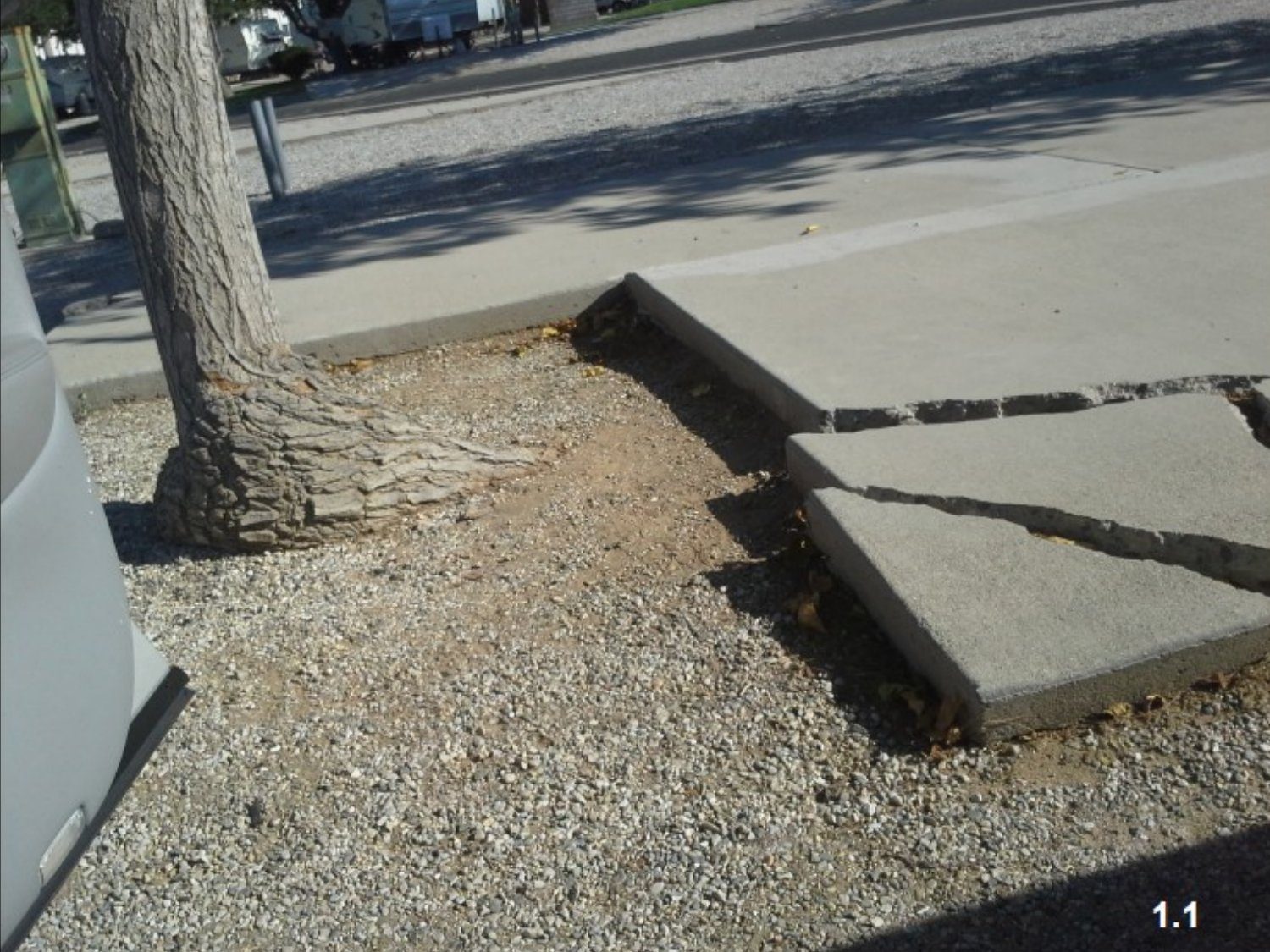
California premises liability injury case exhibit of a cracked concrete pad trip hazard at an RV park
Evidence showed a prior owner had already identified the same cracked walkway years earlier and planned a repair in 2012 that was never completed.

What Happened

Our client's foot became lodged in a deep, separated crack in the concrete pad near her RV, a defect with a height differential of roughly three inches in places, more than enough to catch a shoe and send someone falling forward onto a hard surface. She struck her head on the concrete and suffered a subdural hematoma, a bleed on the surface of the brain that carries elevated risks of lasting cognitive harm in an older adult. The fall happened at an RV park in Hesperia, California, where she lived as a long-term resident.

A Hazard the Property Owner Already Knew About

What made this case especially strong was not just the defect itself but what the evidence showed about the property owner's knowledge. A prior owner of the RV park had already identified this exact hazard years earlier and had planned to fix it in 2012. That fix was never completed. Meanwhile, roughly half of the park's long-term residents were elderly, and the walkway's nighttime lighting was inadequate for safe walking after dark, a detail that made a nighttime fall foreseeable rather than freakish.

How The Homampour Law Firm Proved the Property Owner Was Liable

Under California law, a business that invites the public onto its property has a duty to use reasonable care to keep that property reasonably safe, and the evidence showed that duty was breached on three independent grounds.

A safety engineer's three reasons

The plaintiff's safety engineer testified that the walkway was dangerous for three independent reasons: the cracked and separated concrete itself, the roughly three-inch height differential it created, and inadequate lighting along the path.

A trivial cost of prevention

The same expert established how easy and inexpensive the fix would have been. The crack could have been repaired for as little as $800, or temporarily blocked off with traffic cones for a few hundred dollars. That gap between a trivial cost of prevention and a catastrophic, foreseeable harm sat at the center of the jury's finding.

A foreseeable, not freakish, fall

With roughly half of the residents elderly and the walkway poorly lit at night, a nighttime fall on a three-inch lip was foreseeable. A duty of reasonable care includes inspecting for hazards, repairing known defects, and warning visitors when repairs cannot happen right away.

A San Bernardino County jury rejected the defense effort to blame an elderly resident for the fall.

The Comparative Fault Rule That Protected the Recovery

The RV park's defense followed a strategy familiar to anyone who has dealt with an insurance company after a fall: argue that our client herself was careless, that she should have watched her step more carefully, and that her age and her own conduct were to blame. California law allows a jury to reduce a plaintiff's damages for comparative fault, but only if two separate questions are both answered against the plaintiff. The jury found that our client had, in fact, been negligent. But it also found that her negligence was not a substantial factor in causing her injuries. A substantial factor is more than a remote or trivial cause; it does not need to be the only cause of harm, but it has to actually matter. Because the defense could not prove that her conduct was a real, substantial cause of her fall, her recovery was not reduced by even one percent. Being careless is not the same as causing your own injury, and California law requires proof of both.

The Verdict

In April 2014, the jury returned a verdict of approximately $3,705,917 for our client and her husband. The award included $65,000 in stipulated past medical expenses, $1,150,000 in future medical expenses reflecting the ongoing cost of caring for an elderly subdural hematoma patient, $462,500 in past non-economic damages, and $1,835,417 in future non-economic damages calculated against a 9.5-year life expectancy. Her husband was separately awarded a combined $193,000 in past and future loss of consortium that belonged to him individually. Prior results do not guarantee a similar outcome, and every case depends on its own specific facts and evidence. The Homampour Law Firm works on a contingency fee basis, advancing all costs, so clients pay nothing unless there is a recovery.

Theory pleaded
Jury finding
Total verdict for the couple
Approximately $3,705,917
Future medical expenses
$1,150,000
Future non-economic damages
$1,835,417
Damages reduced for our client's fault
None; her negligence was not a substantial factor

How This Case Was Won, Topic by Topic

The breakdowns below cover the property owner's duty of care under Civil Code section 1714, the substantial factor causation doctrine that defeated comparative fault, mediation strategy in premises cases, and how California dog bite strict liability fits alongside other premises claims.

Referring a catastrophic premises liability case?

We try dangerous condition and catastrophic fall cases as counsel or co-counsel and pay statutory referral fees.

Refer a case

Frequently Asked Questions

What happened in this California premises liability injury case?

Our client, a 71-year-old woman, tripped and fell on a cracked, uneven concrete pad at an RV park in Hesperia, California in April 2014, striking her head and suffering a subdural hematoma. A San Bernardino County jury awarded her and her husband approximately $3.7 million.

Can an elderly person still recover full damages if they were walking carefully?

Yes. The jury found our client was negligent but that her negligence was not a substantial factor in causing her injuries, meaning California law required the defense to prove both carelessness and actual causation, and because it could not prove causation her award was not reduced at all.

How long do I have to file a premises liability claim in California?

California's statute of limitations for a personal injury claim, including a trip-and-fall on someone else's property, is generally two years from the date of the incident, though evidence like a physical hazard can change or be repaired quickly, making prompt documentation important.

Skip to content