
For referring counsel: The California product liability framework gives a plaintiff several independent paths to hold a manufacturer accountable for a defective consumer product. The strongest cases plead all of them. Shinedling v. Sunbeam shows why.
Refer or co-counsel: (323) 658-8077 · [email protected]
Why this matters. A single defect can support strict liability and negligence at the same time, on overlapping but not identical elements. When one theory fails at trial, another can still carry the verdict. The California product liability framework rewards lawyers who plead the full set rather than betting the case on one count.
The five theories at a glance
California recognizes several parallel routes to manufacturer liability for a defective product. The core five are:
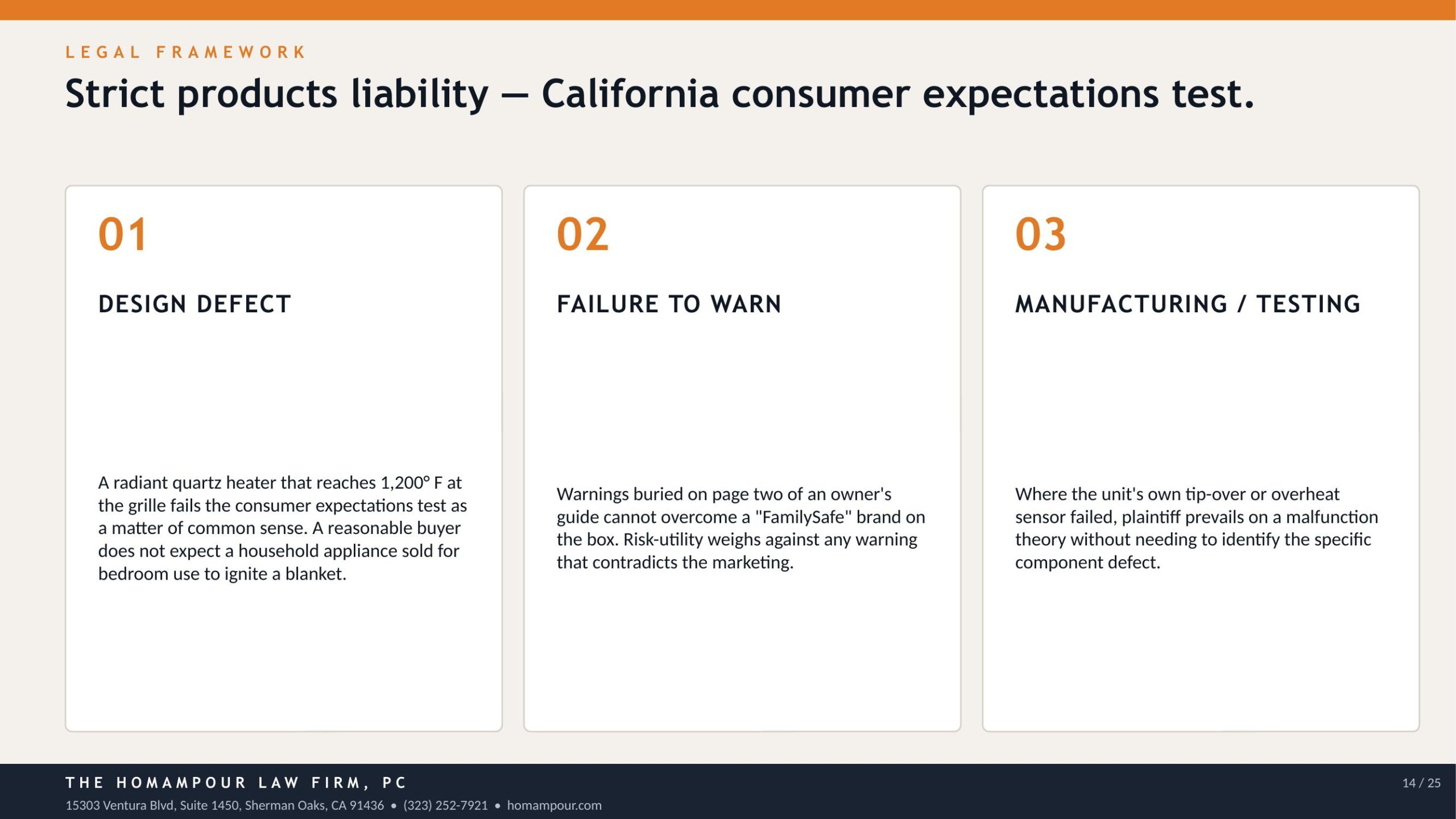
- Strict liability, design defect. Tested two ways under Barker v. Lull Engineering Co. (1978) 20 Cal.3d 413: the consumer-expectation test and the risk-benefit test.
- Strict liability, manufacturing defect. The product departed from its own design or specifications.
- Strict liability, failure to warn. The manufacturer failed to warn of a knowable risk. Anderson v. Owens-Corning Fiberglas Corp. (1991) 53 Cal.3d 987.
- Negligent design. The manufacturer failed to use reasonable care in designing the product.
- Negligent failure to warn. The manufacturer failed to use reasonable care in warning of a foreseeable risk.
Strict liability asks what the product did. Negligence asks what the manufacturer did. The two doctrines close different gaps, which is why both belong in the complaint.
The doctrines that close the loop
A complete California product liability framework also accounts for two further pieces. First, the manufacturer’s affirmative duty to test its products, stay current with safety knowledge, and update warnings as risks become known. Second, comparative fault and Proposition 51, which decide how fault and non-economic damages are apportioned among the parties.
The Shinedling validation
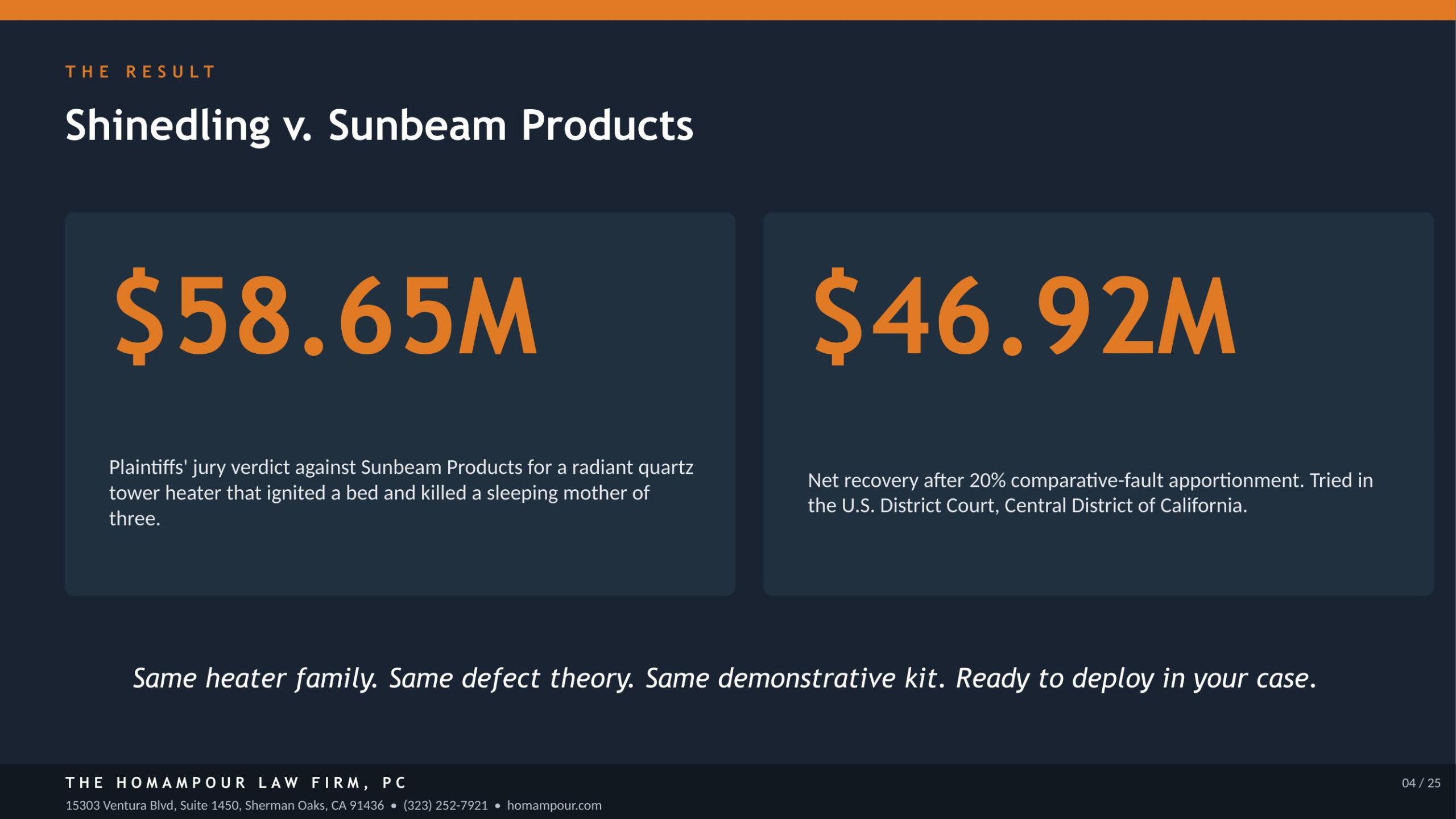
Shinedling v. Sunbeam Products, Inc. (C.D. Cal. 2015) is the proof point. Amy Shinedling died in a January 2011 house fire that started when a Holmes HQH307 radiant quartz heater, designed and made by Sunbeam, failed to shut off after clothing fell in front of it. A federal jury returned a special verdict of $58,650,000, reduced to a net judgment of $46,920,000 after a 20% comparative-fault apportionment. The Ninth Circuit affirmed the wrongful-death portion in 2017.
The structural lesson lives in what the jury did not find. On strict-liability design defect, the jury answered yes on consumer expectation but no on causation, and no on risk-benefit. On strict-liability failure to warn, negligent design, and negligent failure to warn, the jury answered yes on every element. Three parallel theories carried the verdict. A lawyer who had pleaded only design defect would have recovered nothing.
How the doctrines work together
Read the cluster in the order that fits the task. For the foundation, start with Greenman and the origin of strict liability. For design defect, see the two Barker tests and the Soule limits. For the warning claims, see strict-liability failure to warn. The single most important strategy page is why parallel theories win.
Refer or co-counsel
The firm accepts defective-product referrals across California and pays a referral fee consistent with California Rule of Professional Conduct 1.5.1, with a written fee-division agreement and the client’s written consent. Trial co-counsel is also available.
The Homampour Law Firm, PC · 15303 Ventura Blvd, Suite 1450, Sherman Oaks, CA 91436
Refer or co-counsel: (323) 658-8077 · [email protected] · homampour.com
Frequently asked questions
How many product-liability theories should a California plaintiff plead?
Plead every theory the facts support. Strict liability and negligence rest on different elements, and a defect can satisfy several theories at once. In Shinedling the design-defect theory failed while three others carried the verdict, so a narrow pleading would have lost the case.
Does strict liability eliminate the need to prove negligence?
Strict liability does not require proof of negligence, but it does not replace the negligence theories. The negligence counts reach the manufacturer’s actual conduct, which can matter for both liability and the damages story.
What is the difference between the consumer-expectation and risk-benefit tests?
The consumer-expectation test asks whether the product performed as safely as an ordinary consumer would expect. The risk-benefit test asks whether the design’s risks outweigh its benefits, and it shifts the burden to the manufacturer once the plaintiff shows the design caused the injury.
Free download
The space-heater demonstrative kit is available as a PDF and an editable PPTX.
Past results do not guarantee similar outcomes. Every case is different, and the value of any claim depends on its specific facts. This page is attorney advertising and general information, not legal advice, and it does not create an attorney-client relationship.